

Pharmaceutical Granulation Equipment: Types, Working & Applications
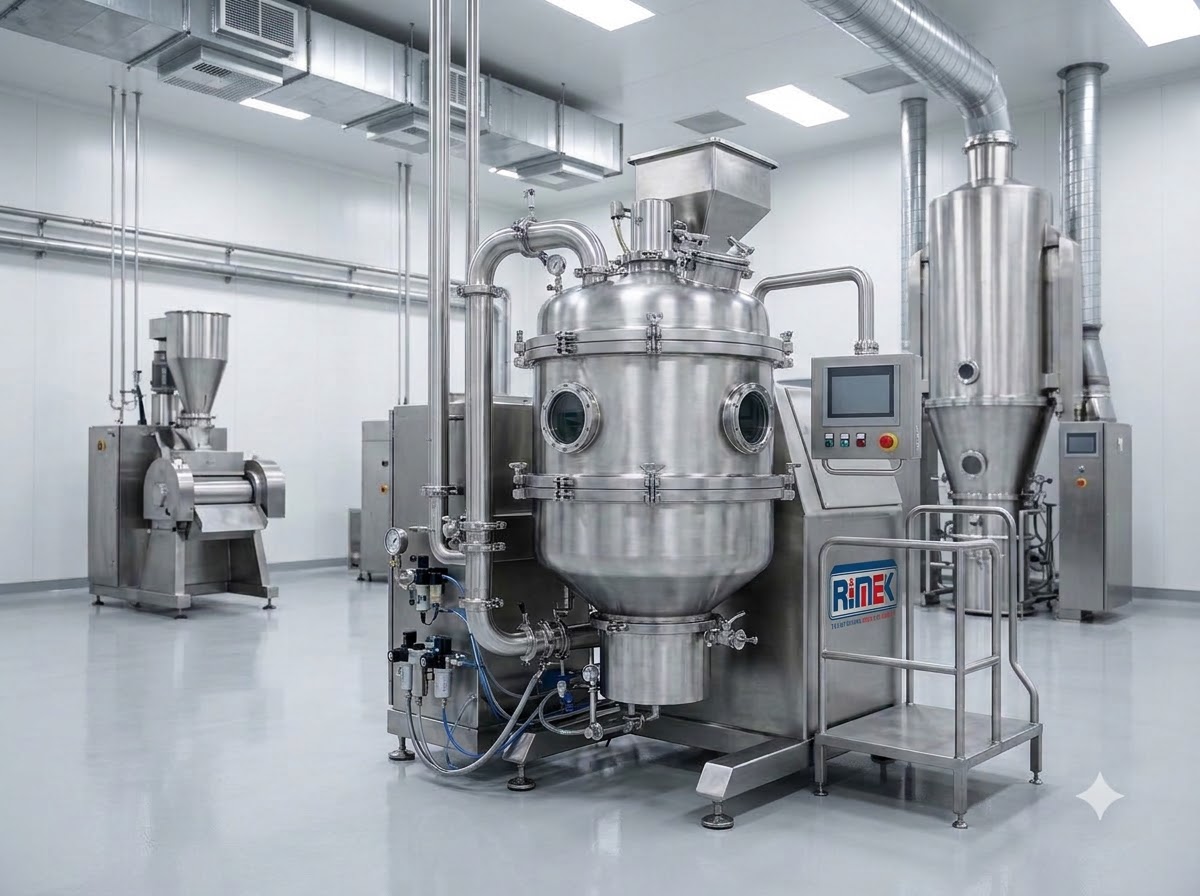
A tablet press only performs as well as the material it receives. Fine pharmaceutical powders tend to segregate, cling to surfaces, trap air and flow unevenly into the die cavity. The result is tablets with inconsistent weight, hardness and drug content. Granulation addresses these problems before compression, turning loose powder into free-flowing granules that behave predictably downstream.
This guide covers the main types of granulation equipment, how each works, where each fits and what to consider before buying.
What Is a Granulation Machine?
A granulation machine converts fine powder particles into larger, more uniform agglomerates called granules. It does this by binding particles together with a liquid binder (wet granulation) or by compacting them under pressure (dry granulation).
The target is not simply bigger particles. Good granules have controlled size distribution, adequate density, reasonable strength and the right flow behaviour. These properties decide how well the material fills a die, compresses into a tablet or fills a capsule.
Why Is Granulation Important in Pharmaceutical Manufacturing?
Powder flowability. Fine powders are cohesive. Granules flow more smoothly through hoppers and feeders, which supports steady die filling at production speeds.
Content uniformity. When a small amount of active ingredient is blended with larger quantities of excipients, the particles can separate during handling. Granulation locks the components together, so each tablet carries a more consistent dose.
Compression performance. Granules usually compress better than raw powder, forming tablets with more reliable hardness and lower capping or lamination risk.
Granule size consistency. A narrow size distribution reduces weight variation and improves the repeatability of the compression run.
Production efficiency and product quality. Less dust, fewer stoppages and better yield all follow from well-formed granules, which supports consistent batch-to-batch quality.
Different Types of Pharmaceutical Granulation Equipment
High Shear Mixer Granulator
A High Shear Mixer Granulator combines mixing and granulation in a single closed bowl. An impeller circulates the powder bed while a chopper breaks up lumps and distributes the binder. Dry powders are blended first, binder liquid is added, and the wet mass develops into granules within minutes.
Because mixing and agglomeration happen together, it is widely used for wet granulation of tablet formulations. Typical benefits include short processing times, dense granules and good binder distribution. Endpoint judgement matters, since over-wetting produces oversized, overly hard granules.
Fluid Bed Processor
In a Fluid Bed Processor, heated air is passed upward through the product bowl, suspending the particles in a fluidised state. This gives exceptionally even heat and mass transfer, which makes it effective for drying wet granules.
The same equipment can also granulate by spraying binder onto fluidised powder, and it supports other operations such as coating, depending on the configuration. Its strength is uniform drying with controlled temperature, which protects heat-sensitive materials.
Wet Granulation Machine
A Wet Granulation Machine covers any equipment used to form granules through liquid binder: high shear mixers, planetary mixers and fluid bed systems among them. The process involves dry mixing, binder addition, wet massing, wet milling if needed, and drying.
Wet granulation suits formulations that need strong, dense granules or improved compressibility. It does add steps and requires drying control, so it is best matched to ingredients that tolerate moisture and moderate heat.
Dry Granulation Machine
A Dry Granulation Machine forms granules without any liquid. Powder is compacted under pressure into dense sheets or slugs, then milled to the required size. With no solvent or drying stage, the route suits moisture-sensitive or heat-sensitive actives and can shorten the overall process.
The trade-off is that the powder needs enough natural bindability to hold together once compacted, and some fines are generated during milling that may need recycling.
Roll Compactor Machine
A Roll Compactor Machine is the most common tool for dry granulation. Powder is fed between two counter-rotating rolls that squeeze it into a continuous ribbon. The ribbon then passes through a mill or granulator, producing granules of the desired size.
Roll force, roll gap and feed rate are the key variables. Together they control ribbon density, which in turn shapes the final granule properties. Karnavati Engineering lists a Roll Compactor in its granulation range.
How Does the Pharmaceutical Granulation Process Work?
Although the details vary by route, the sequence usually looks like this:
-
Material preparation. Active ingredients and excipients are weighed and, where required, sieved to remove lumps.
-
Dry mixing. Powders are blended to distribute the components evenly.
-
Granule formation. In wet granulation, binder solution is added and the wet mass forms. In dry granulation, the blend is compacted into ribbons or slugs.
-
Wet milling (wet route). A mill breaks up oversized wet lumps so drying is uniform. A Wet Cone Mill is often used for this step.
-
Drying. Moisture is removed, commonly in a fluid bed processor, until the granules reach the target moisture level.
-
Sizing. Dried granules or milled ribbons are passed through a mill and sieve to reach the desired size distribution.
-
Final blending. Lubricant and other external excipients are added before the material goes to compression or capsule filling.
Wet Granulation vs Dry Granulation: Key Differences
|
Parameter |
Wet Granulation |
Dry Granulation |
|
Process |
Liquid binder binds particles into granules |
Powder is compacted mechanically, then milled |
|
Moisture requirement |
Requires a liquid binder and drying |
No liquid or drying step |
|
Equipment used |
High shear mixer granulator, fluid bed processor, wet mill |
Roll compactor, slugging equipment, mill |
|
Processing stages |
Mixing, wetting, wet milling, drying, sizing |
Mixing, compaction, milling, sizing |
|
Suitable applications |
Materials that tolerate moisture and heat; need for dense, strong granules |
Moisture- or heat-sensitive materials; powders with good binding behaviour |
|
Important considerations |
Endpoint control, drying time and uniformity |
Roll force settings, fines generation, ribbon quality |
Neither route is universally better. The right choice depends on the stability and compressibility of the formulation.
Applications of Granulation Machines in Different Industries
Pharmaceutical tablets and capsules are the primary use, but granulation principles apply wherever powders need better handling:
-
Pharmaceuticals: Oral solid dosage forms, including tablets and capsule fills.
-
Nutraceuticals and Ayurvedic products: Herbal and supplement powders often benefit from granulation for flow and uniform dosing.
-
Food and confectionery: Powdered ingredients can be granulated to reduce dust and improve consistency.
-
Chemicals and agrochemicals: Granulated forms are easier to handle, store and dose.
Process requirements and hygiene standards differ by industry, so equipment should be matched to the sector’s specific needs.
How to Choose the Right Granulation Machine?
Start with the material. Flowability, moisture sensitivity, heat sensitivity and binding behaviour largely decide whether the wet or dry route makes sense.
Next, define scale. Production capacity and batch size determine whether you need laboratory, pilot or production equipment. R&D teams often prefer small-batch units for formulation work before scale-up.
Then consider the output you need: granule size, density and strength. Work backward from the tablet or capsule specification.
Other factors worth weighing:
-
Equipment configuration: Standalone units versus an integrated granulation line, and how the machines connect to milling, drying and blending.
-
Cleaning and maintenance: Easy-to-clean contact parts and accessible design reduce downtime and cross-contamination risk.
-
Manufacturing requirements: Regulatory expectations, documentation needs, operator skill levels and available floor space.
-
After-sales support: Spares availability and service response matter over a machine’s whole life.
Why Choose the Right Pharmaceutical Granulation Equipment?
Granulation sits early in the manufacturing chain, so errors compound later. A mismatched machine can produce granules that compress poorly, dry unevenly or vary between batches, problems that are costly to correct at the tablet press. Equipment suited to your product and process gives more predictable results, smoother scale-up and less rework.
Frequently Asked Questions About Granulation Machines
1. What is a granulation machine used for?
It converts fine powders into free-flowing granules that are easier to blend, compress into tablets or fill into capsules.
2. What is the difference between wet and dry granulation?
Wet granulation uses a liquid binder and requires drying. Dry granulation compacts powder under pressure with no liquid, making it more suitable for moisture-sensitive materials.
3. What does a high shear mixer granulator do?
It mixes powders and forms granules in one bowl, using an impeller and chopper to distribute binder and build granules quickly.
4. What is the purpose of a fluid bed processor?
It dries granules in a stream of heated air, giving even drying. Depending on configuration, it can also granulate or coat material.
5. When is a roll compactor machine used?
When a formulation is moisture- or heat-sensitive, or when the process should avoid liquid and drying steps. It compacts powder into ribbons that are then milled into granules.
6. Which equipment is commonly used in pharmaceutical granulation?
High shear mixer granulators, fluid bed processors, roll compactors, wet and dry mills, and sifters or sieve shakers.
7. How do you select a suitable granulation machine?
Assess material characteristics, batch size, target granule properties, wet or dry requirements, cleaning needs and long-term service support.
8. Does every formulation need granulation?
No. Some powders flow and compress well enough for direct compression. Granulation is used when flow, uniformity or compressibility needs improvement.
Granulation determines how well a formulation moves, blends and compresses. Understanding the roles of the high shear mixer granulator, fluid bed processor and roll compactor machine, and when to use wet or dry routes, helps manufacturers make informed equipment decisions.
Karnavati Engineering, now operating as IRM Enterprises Pvt. Ltd. under the Rimek brand, has supplied pharmaceutical machinery since 1981. Its range includes tablet compression machines, capsule filling machines and a granulation line. To explore the granulation machine range or discuss your requirements, contact the team.