

Tablet Press Machine: Working Principle, Main Components, and Their Functions
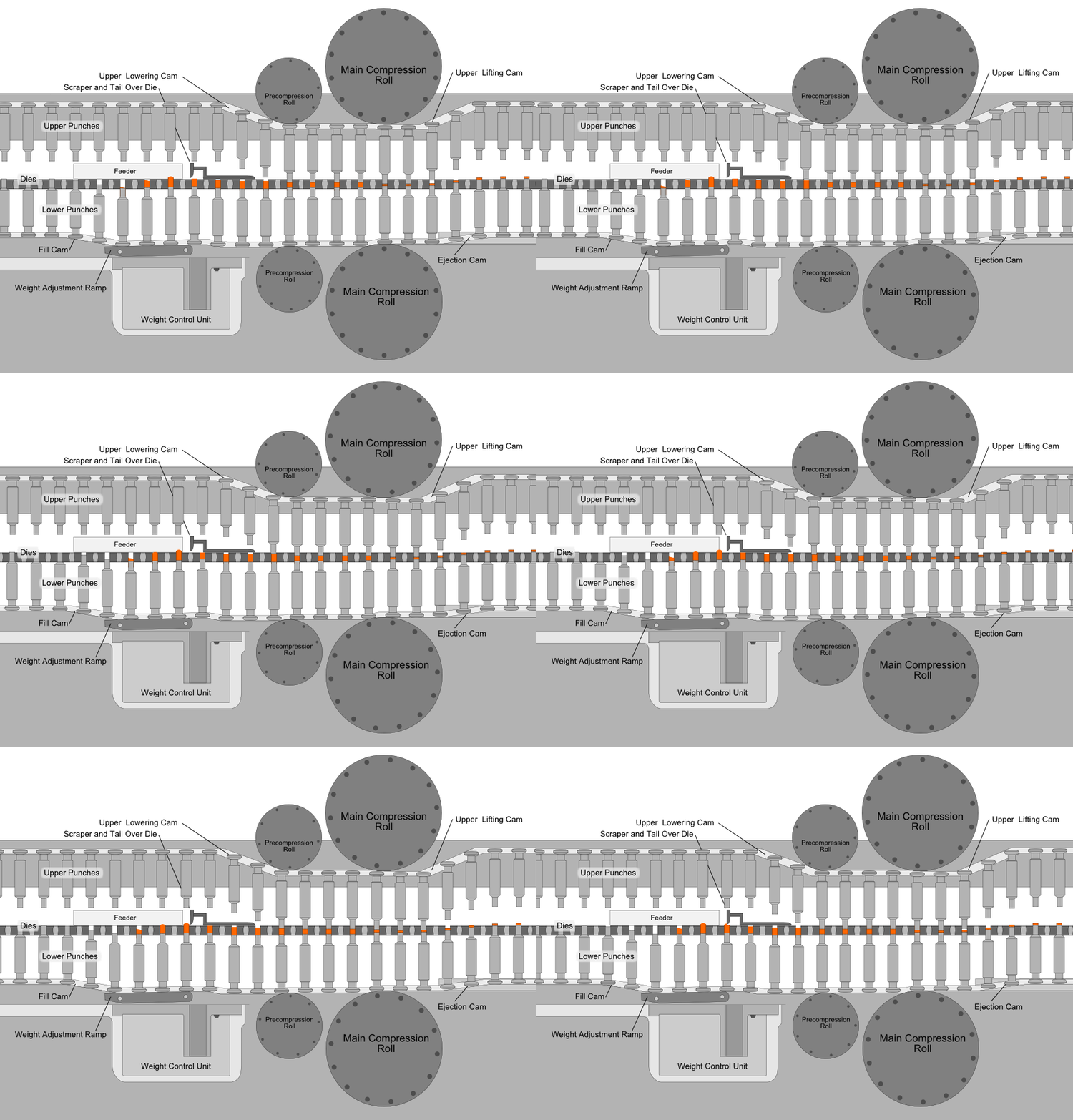
The tablet manufacturing process is one of the most critical operations in the pharmaceutical industry. Every tablet must meet strict standards for weight, hardness, thickness, and dosage accuracy. To achieve this level of consistency, manufacturers rely on advanced equipment known as the Tablet Press Machine.
A tablet press machine is designed to compress powders or granules into tablets of uniform shape and size. These machines are widely used across the pharmaceutical, nutraceutical, food, chemical, and cosmetic industries to produce tablets efficiently and at high production rates. Modern tablet press machines combine precision engineering, automation, and robust construction to ensure reliable and GMP-compliant manufacturing.
Understanding how a tablet press machine works and the role of its major components is essential for anyone involved in pharmaceutical production. This article explores the working principle of tablet press machines and explains the key components responsible for efficient tablet compression.
What Is a Tablet Press Machine?
A Tablet Press Machine, also known as a tablet compression machine, is pharmaceutical equipment used to convert powders or granules into compressed tablets. The machine applies mechanical force to the formulation inside a die cavity, transforming loose powder into a solid dosage form.
The process involves filling the die cavity with material, compressing it under controlled pressure using punches, and ejecting the finished tablet. This cycle is repeated continuously, allowing manufacturers to produce thousands of tablets per hour with consistent quality.
Tablet press machines are available in different configurations, including single-station tablet presses for research and development and high-speed rotary tablet presses for large-scale commercial production.
Working Principle of a Tablet Press Machine
The working principle of a tablet press machine is based on the controlled application of compression force. The machine compresses a measured quantity of powder or granules inside a die cavity to form a tablet with the desired characteristics.
Powder Feeding
The tablet manufacturing cycle begins with the feeding of powder or granules into the machine's hopper. The hopper acts as a storage unit and supplies material to the feed frame. The feed frame distributes the material evenly into the die cavities as the turret rotates.
Proper powder feeding is essential because it directly affects tablet weight uniformity and content consistency. Modern tablet press machines are equipped with advanced feeding systems that ensure accurate die filling even at high production speeds.
Compression Stage
Once the die cavity is filled, the lower punch rises while the upper punch descends into the die. The powder is compressed between the two punches under a predefined force.
During compression, the particles bond together to form a solid tablet. The compression force can be adjusted depending on the formulation requirements and desired tablet hardness.
This stage is critical because it determines important tablet characteristics such as strength, friability, thickness, and dissolution performance.
Tablet Ejection
After compression is complete, the upper punch retracts while the lower punch rises to push the finished tablet out of the die cavity.
The tablet is then guided toward a collection chute or conveyor system for further processing such as coating, inspection, packaging, or storage.
This continuous sequence of filling, compression, and ejection allows tablet press machines to operate efficiently and maintain high production output.
Main Components of a Tablet Press Machine
A tablet press machine consists of several precision-engineered components that work together to ensure accurate and efficient tablet production.
Hopper
The hopper serves as the storage container for the powder or granules before compression. It continuously feeds material into the machine and ensures a steady supply throughout the production process.
The design and capacity of the hopper may vary depending on machine size and production requirements. A properly designed hopper promotes smooth material flow and minimizes bridging or segregation.
Feeder System
The feeder controls the movement of powder from the hopper into the die cavities. Its primary function is to distribute material uniformly and maintain consistent tablet weight.
Depending on the formulation characteristics, tablet press machines may utilize gravity feeders, force feeders, or vacuum-assisted feeding systems. Efficient feeding is particularly important for high-speed tablet manufacturing applications.
Die
The die is one of the most critical components of a tablet press machine. It contains the cavity where powder compression takes place and determines the shape, diameter, and thickness of the tablet.
Dies can be manufactured in various sizes and configurations to accommodate different tablet designs, including round, oval, capsule-shaped, and custom forms.
Upper and Lower Punches
The punches are precision metal tools that apply compression force to the powder inside the die cavity.
The upper punch moves downward while the lower punch provides support from below. Together, they compress the material and form the tablet. The shape of the punch tip determines the tablet's final appearance, while the compression force influences tablet hardness and durability.
High-quality punches are essential for maintaining tablet consistency and minimizing tooling wear.
Turret
The turret is a rotating component that holds multiple sets of punches and dies. As the turret rotates, each station passes through filling, compression, and ejection zones.
In rotary tablet press machines, the turret enables continuous production and significantly increases manufacturing capacity. The number of stations on the turret directly impacts machine output and productivity.
Cam Track
The cam track controls the movement of the punches throughout the compression cycle. It guides the punches through precise positions during filling, compression, and ejection operations.
By controlling punch movement, the cam track plays a crucial role in determining dwell time, compression force, and overall tablet quality.
Ejection Mechanism
The ejection mechanism is responsible for removing the finished tablet from the die cavity after compression.
A well-designed ejection system ensures smooth tablet release without damaging the tablet surface. Depending on the machine design, ejection may be mechanical, pneumatic, or hydraulic.
The mechanism then directs tablets to the discharge chute for collection and downstream processing.
Why Modern Tablet Press Machines Are Important
Modern pharmaceutical manufacturers require equipment capable of delivering high productivity while maintaining strict quality standards. Advanced tablet press machines provide precise control over compression parameters, minimize material wastage, and support GMP-compliant production environments.
With features such as automatic weight control, real-time monitoring, touchscreen interfaces, and high-speed operation, today's tablet press machines play a vital role in ensuring efficient and reliable tablet manufacturing.
A tablet press machine is the heart of pharmaceutical tablet production. From powder feeding and compression to tablet ejection, every stage of the process depends on the coordinated operation of multiple machine components. The hopper, feeder, die, punches, turret, cam track, and ejection mechanism each contribute to producing tablets with consistent weight, hardness, and quality.
As pharmaceutical manufacturing continues to evolve, modern tablet press machines remain essential for achieving high production efficiency, regulatory compliance, and superior product quality. Understanding their working principle and components helps manufacturers optimize operations and ensure reliable tablet production at every stage.