

Single Station vs Rotary Tablet Press Machine: Which One Should You Buy?
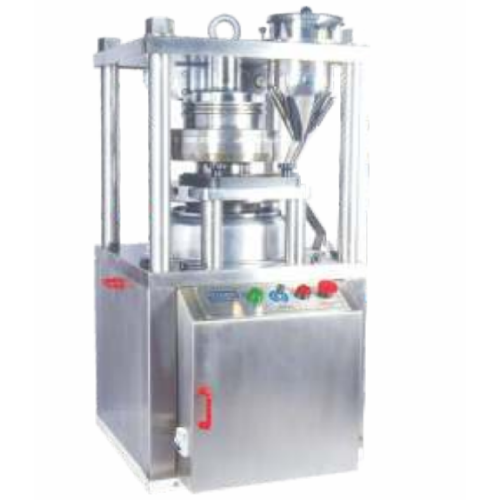
Choosing the right Tablet Press Machine is important for pharmaceutical manufacturers because the machine directly affects production capacity, tablet quality, operating efficiency, and overall manufacturing costs.
Two commonly considered options are the Single Station Tablet Press Machine and the Rotary Tablet Press Machine. While both are designed for tablet compression, they serve different production requirements.
A single station press is generally suitable for small-scale production, laboratory work, and formulation development, whereas a rotary tablet press is designed for higher production volumes and continuous manufacturing.
So, which one should you choose? Let’s compare them.
What Is a Tablet Press Machine?
A Tablet Press Machine is pharmaceutical machinery used to compress powders or granules into tablets of a specific weight, shape, thickness, and hardness.
The machine performs essential operations such as filling the die, compressing the material, and ejecting the finished tablet.
Tablet presses are widely used in pharmaceutical, nutraceutical, Ayurvedic, veterinary, chemical, and other industries where tablet production is required.
Single Station Tablet Press Machine
A Single Station Tablet Press Machine uses a single set of punches and dies to compress the material into tablets.
Its relatively simple design makes it suitable for:
-
R&D and laboratory applications
-
Small-batch production
-
Product development
-
Formulation trials
-
Low-volume manufacturing
Key Benefits
-
Compact machine design
-
Simple operation
-
Suitable for small batches
-
Convenient for formulation trials
-
Lower initial investment compared with larger production systems
-
Easy to operate and maintain
However, its production capacity is limited compared with a rotary tablet press, making it less suitable for high-volume commercial manufacturing.
Rotary Tablet Press Machine
A Rotary Tablet Press Machine uses multiple punches and dies arranged around a rotating turret. As the turret rotates, several tablets can be compressed during each revolution.
This design makes rotary tablet presses suitable for medium- and large-scale pharmaceutical production.
Key Benefits
-
High production capacity
-
Continuous tablet compression
-
Multiple compression stations
-
Suitable for commercial production
-
Greater automation options
-
Consistent production when properly configured
-
Suitable for scaling up manufacturing
Modern rotary machines can also incorporate features such as pre-compression, force feeding, automatic lubrication, variable-speed control, and PLC/HMI-based operation, depending on the model.
Single Station vs Rotary Tablet Press Machine
|
Feature |
Single Station |
Rotary Tablet Press |
|
Production Volume |
Small |
Medium to High |
|
Compression Stations |
Single |
Multiple |
|
R&D Applications |
Excellent |
Suitable |
|
Commercial Production |
Limited |
Excellent |
|
Machine Complexity |
Simple |
Advanced |
|
Automation |
Basic |
Advanced options |
|
Initial Investment |
Generally lower |
Generally higher |
|
High-Speed Production |
Not ideal |
Suitable |
|
Small-Batch Production |
Suitable |
Possible |
|
Future Scale-Up |
Limited |
Excellent |
Which Tablet Press Machine Should You Buy?
The right machine depends mainly on your production volume and application.
Choose a Single Station Tablet Press if you:
-
Need a machine for R&D
-
Produce small batches
-
Frequently test formulations
-
Have limited production requirements
-
Need a compact and simple solution
Choose a Rotary Tablet Press if you:
-
Require higher production capacity
-
Manufacture tablets commercially
-
Need continuous production
-
Plan to increase production in the future
-
Require greater automation and process control
For pharmaceutical manufacturers with significant production requirements, a Rotary Tablet Press Machine is generally the more suitable long-term solution.
Important Factors Before Buying a Tablet Compression Machine
Production capacity should not be the only factor when selecting a Tablet Compression Machine. Consider:
Tablet specifications: Check the required tablet size, shape, thickness, and tooling configuration.
Production requirement: Calculate the required tablets per hour and expected future production.
Formulation: Powder flowability, compressibility, moisture, and granule characteristics can affect machine performance.
Compression force: Select equipment capable of handling the required compression force for your formulation.
Automation: Consider whether you require PLC/HMI controls, automatic lubrication, force monitoring, or other automation features.
Maintenance and service: Availability of spare parts, technical support, and trained service personnel is important for long-term operation.
GMP requirements: Pharmaceutical production equipment should be selected with applicable GMP, hygiene, cleanability, and safety requirements in mind.
Why Choose the Right Tablet Press Machine?
Selecting the right Tablet Press Machine can help manufacturers achieve better production efficiency, consistent tablet quality, and reliable operation.
A machine should therefore be selected according to the formulation, production volume, tablet specifications, and future manufacturing requirements—not simply based on its maximum advertised output.
Both single station and rotary tablet presses have their own applications.
A Single Station Tablet Press Machine is a practical choice for R&D, formulation development, and small-batch production. A Rotary Tablet Press Machine is better suited to higher-volume pharmaceutical manufacturing where productivity, consistency, and scalability are important.
If you are looking for a reliable Tablet Compression Machine, evaluate your current production requirements as well as your future capacity before making a purchase.
Karnavati Engineering offers pharmaceutical machinery solutions designed for different tablet manufacturing requirements. Selecting the appropriate machine configuration can help ensure efficient and dependable tablet production.